lunes, 3 de abril de 2017

4. TYPES OF CURRENT

4.1 Direct current


Between the terminals of a battery, there is a continous, stable flow of energy. This is called direct current.

4.2 Alternating current


If we measured the voltage of an electrical socket, the results could be represented in a graph like the one below:


The variation of any electrical parameter over a period of time (in this case the electric current) is an electric signal.
The tension or voltage of domestic electricity is an alternating signal because it alternates between positive and negative values. Its waveform is also sinusoidal, with a smooth, regular shape.

4.3 The efficiency of alternating current 

The average power of alternating current is equal to the direct current that is needed to produce the same effect. In the case of an alternating sinusoidal, current, the average power would be as foollows

                                                                       V ef=V max/(Square root) 2

4.4 Transformers

Is a difference between alternating and direct current. Alternating current can be increased or decreased by a transformer.
Transformer consist of two windings made of copper wire. If we apply an .alternating current to one of them, it will produce a certain voltage in the other.


sábado, 1 de abril de 2017

3.TYPES OF CIRCUITS

3.1 Serie circuit


Two or more elements form a series circuit when the output of one element provides the input for the next element.

To calculate the total resistance of a circuit, we add the resistance values of each load:

                                                       R=R1+R2+R3+...


3.2 Parallel circuit


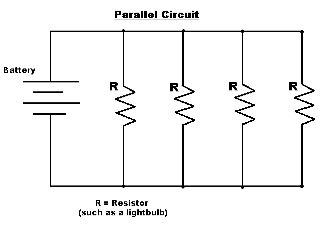
In a parallel circuit, the various components share the same input and output. In other words, the wires from  both sides are joined together.

If identical batteries are connected in parallel, the voltage of the circuit will not increase.

3.3 Combination circuit.


 A combination circuit has some elements conneted in series and other elements connected in parallel.


In this circuit, the current remains constans between elements that are connected in series.
Then we can calculate the current from each power source, and lastly the various voltages.


2. ELECTRICAL QUANTITIES

2.1 Voltage or potencial difference.


The amount of energy that a generator can transfer to electrons depends on its voltage or electric tension. This measured in volts

If we to measure voltage, we can a voltmeter. This device has tow wires that must be connected in parallel to the element that we are cheking

2.2 Measuring electrical current


Electrical current is the charge or number of electrons that flow through the cross-section of a conductor every second. We can express this mathematically as-folows.

we can use an ammeter to measure electric current. This instrument is connected in series, so that all the electrons must pass through it.

2.3 Electrical resistance: ohm's law.


The resistance of a material is equal to the voltage divided by the intensity of the electric current which travels through the materials. This ratio, which is called Ohm's law, can be expressed as follows.

                                                      R=V/I

2.4 Electrial energy and power.


Electrical energy.
If an electric current flows at a particular tension for a certain amount of time, we can calculate the energy that is consumed. E=V x I x t

Electrical power.
If an electric current flows at a particular tension, we can calculate the power that is consumed. 
                                                   P=V x I
we simply multiply the power in kilowatts by the amount of time in hours.


7. ELECTRIC CIRCUITS AND ELECTRONICS

1. An electric circuit


An electric circuit is a pathway for the flow of electrons. It consists of the following parts, which are connected by wires.
Electric current is a continous flow of electrons through a circuit.


1.1 Parts of an electric circuit


Electric circuits consist of varirous parts:

Generators: Is a cells and batteries


Loads: Is a motors, resistor, ligth bulb and bells.

this is a resistor.


Switching devices: Is a switches, push buttons  and 3-way switches.

Is a push buttons.

1.2 Diagrams and symbols. 


We use a system of conventional symbols to simplify the visual representation of electric and electronic circuits, making them easier to understand.


viernes, 17 de marzo de 2017

IMPACTO AMBIENTAL


¿Qué es la energía?


La energía es la capacidad de un cuerpo para realizar transformaciones y hacer el trabajo. No puede ser destruido o creado, sólo puede ser transformada. Los seres humanos toman su energía de los alimentos, y después de transformar esta energía en energía metabólica y muscular. Los dispositivos modernos necesitan energía eléctrica, por ejemplo; coches tienen motores que usan gasolina o diesel como fuente de energía.


➡ formas de energía.

En la naturaleza, estas formas de energía se pueden manifestar de distintas formas:

POTENCIAL: Asociado a la altura de un objeto sobre el suelo, o el almacenamiento de energía en un resorte.
CINÉTICA: La energía del movimiento físico.
MECÁNICA: La suma de la energía potencial y cinética.
SONIDO: La energía de las ondas sonoras, que son procedidas por las vibraciones y propagan mediante un medio físico.
ELÉCTRICO: El producto de una corriente eléctrica.
NUCLEAR: La energía en el núcleo de un átomo.
LUMINOSO: Asociado a la luz.
TÉRMICA o calorífica: Asociado al seno del movimiento de las partículas en la materia.
QUÍMICA: Los resultados de la formación o descomposición de las sustancias. Por ejemplo, la energía metabólica es generada por los organismos que llevan a cabo las transformaciones químicas durante la digestión y la respiración viviente.
Electromagnética: Se produce cuando las corrientes eléctricas crean campos magnéticos.

➡ UNIDADES DE MEDIDA DE ENERGÍA.

La energía se mide en julios (J), y cuando toma la forma de calor, que lo expresan como calorías. Relación: 1 cal = 4.18 J.

➡ POWER.

La potencia es la cantidad de trabajo que puede hacer una máquina en una cierta cantidad de tiempo. Relación: P = W / t. (W: obra expresada en julios y t: tiempo expresado en segundos)
en las máquinas, la salida es siempre menor bronceado su aporte de energía. Esto sucede porque parte de la energía se pierde siempre a la fricción, la vibración y el calor. Relación:

la eficiencia de conversión de energía (%) = salida / entrada * 100


Transformaciones de energía


Todos los días, se producen transformaciones de la energía. Cuando se transfome energía, se puede producir algunas formas no deseadas de energía. Los siguientes ejemplos muestran cómo:

Cuando se frota las manos, transformamos la energía química en nuestros músculos en energía cinética, y después, la energía cinética se pueden transformar en energía térmica.

La energía química de los fuegos artificiales se convierte en luz, calor, sonido y energía mecánica cuando se explote.

La energía nuclear en estrellas se transforma en energía luminosa y térmica muy intenso.


Sourcer energía


Las fuentes de energía son los recursos naturales que podemos utilizar para generar diferentes formas de energía y podemos transformar esa energía para diversos fines. Podemos clasificar en dos categorías generales: ↠ fuentes de energía no renovables.


Vienen de los recursos naturales que son limite y pueden ser agotados, y llevaría millones de años para regenerarse. Son las fuentes de energía más utilizadas. Incluyen los combustibles fósiles y la energía nuclear, que utiliza materiales radiactivos, como el uranio


↠ las energías renovables.

Vienen de los recursos naturales que no podemos utilizar por completo. Incluyen, marinos,, geotermal y biomasa recursos solares hidroeléctricas, así como la energía que se puede producir a partir de residuos sólidos urbanos.


La energía eléctrica


Es una forma de energía que se transporta por una corriente eléctrica. La electricidad es la más útil en el mundo por dos razones:

⤷It puede transformarse en otros tipos de energía así que es mejor que otros.
⤷It pueden ser transportados a grandes distancias más baratos y más eficientes.


Estaciones de energía eléctrica.


Una central eléctrica es un lugar cuando la energía a partir de recursos naturales se transfromed en la energía que podemos utilizar. Depende de la energía que va a generar, recibes un nombre u otro.

¿Cómo se genera la electricidad? Si queremos transformar la energía en electricidad, que use generators y si se utilizan generadores en las centrales eléctricas, llamados alternadores. Un alternador es compone por un estator y un rotor. El rotor tiene un números pares de bobinas que reciben corriente continua. Ellos producen un campo electromagnético. 
Aturbine gira el eje del rotor y generar la corriente eléctrica. Este sistema se utiliza en todas las estaciones de alimentación, excepto para las estaciones fotovoltaicas. 
El transporte y distribución de electricidad. 
Centrales eléctricas, por lo general, son lugar en zonas lejos de las áreas en las que utilizamos la energía eléctrica por razones de seguridad, por necesidad o espacio para las características geográficas. La energía eléctrica no se puede almacenar. No requiere muchos pasos en el progreso de transporte de energía: 
1. El aumento de la tensión: se eleva la tensión, por los transformadores a los altos voltajes, debido a que la electricidad debe pasar a través de grandes distancias. 
2. líneas de alto voltaje: las rutas que las torres donde se intalled las líneas son cuidadosamente planificadas. 
3. La reducción de la tensión: Las subestaciones, que se instalan entre las líneas de alta tensión y los consumidores finales, utilizan transformadores para reducir la potencia a voltajes más bajos. 4 Por último, la energía se distribuye a los edificios, industrias e instalaciones públicas. Te líneas eléctricas están instalados en postes o bajo tierra. La tensión se reduce, dependiendo de la cosumer final.


ESTACIONES DE ENERGÍA NUCLEAR.


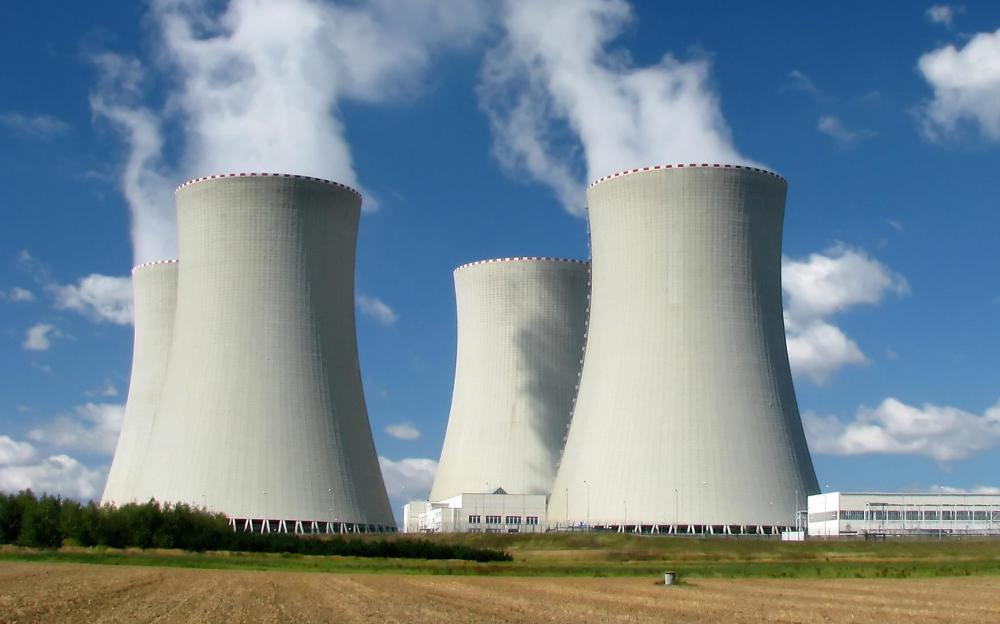
Este tipo de centrales eléctricas utilizan reactores nucleares, que usa materiales radiactivos (especialmente los isótopos de uranio), para producir calor.


Las centrales nucleares producen una gran cantidad de energía que podemos vendido a un beneficio, pero, en estas centrales pasa muchos accidentes y almacenamiento de residuos radiactivos.

Las centrales eléctricas que utilizan fuentes de energía no renovables

Hay dos tipos: las centrales térmicas y centrales nucleares.

Las centrales térmicas que utilizan combustibles fósiles.

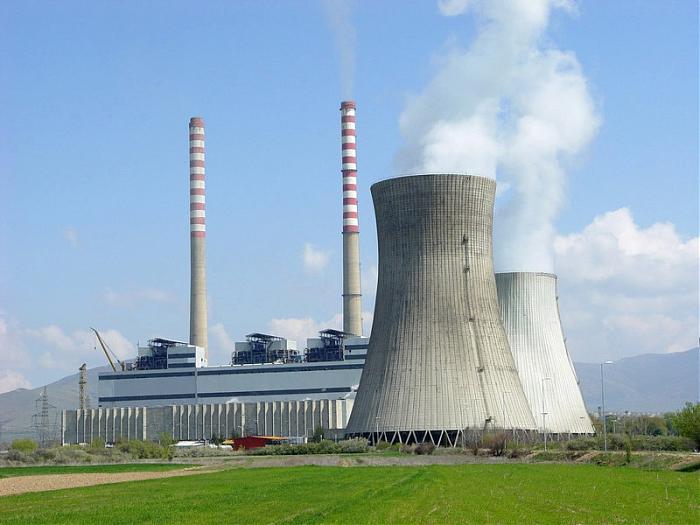
Este tipo de centrales eléctricas utilizan combustibles fósiles para generar energía térmica, para luego convertir la energía térmica en energía mecánica.


Las centrales térmicas trabaja con carbón, petróleo y gas natural que calentar el agua en una caldera. En la caldera se vuelve aturbine conectado al rotor de un generador. La energía producida por el generador es transportado por una red de líneas de alta tensión. El vapor va a un condensador, donde se enfría y se convierte en agua líquida. Finalmente, el agua se bombea de nuevo a la caldera.

Centrales de ciclo combinado.


En las centrales de cogeneración, la electricidad se genera en dos sistemas. La primera, se quema el gas natural con aire comprimido, y entonces se produce gases sobrecalentados, que convierten una turbina para generar electricidad.

El segundo utiliza los gases calientes anteriores y los utiliza para producir vapor en una caldera de calor recuperar. Finalmente, el vapor se convierte en una turbina para generar más electricidad. Estos son los motivos de centrales de ciclo combinado son más eficientes que la sola.


Centrales geotérmicas.


Estas centrales utilizan el calor natural desde la superficie de la Tierra como agua caliente, vapor y gases calientes. Ellos pueden ser el uso de dos formas:

Se puede utilizar directamente para proporcionar agua caliente para usos de calefacción e industriales.
Se puede utilizar indirectamente para accionar generadores y producir electricidad.

Los parques eólicos son muy baratos en comparaison con otras centrales eléctricas, y son una fuente totalmente limpia de energía. La producción total de un parque eólico depende del número y tamaño de las turbinas.

Las centrales hidroeléctricas.


Estas centrales utilizan la energía de la caída del agua para producir energía. Centrales hidroeléctricas funcionan con un recevoir, que acumulates agua detrás de una presa. La energía cinética producida mueve las palas de las turbinas y el generador conectado en las turbinas producir energía. Hay dos tipos de centrales hidroeléctricas:

➝ centrales hidroeléctricas convencionales: el agua fluye desde la artesa recevoir un conducto donde el agua está en alta compresión. A continuación, se desemboca en un río.


Las centrales eléctricas que utilizan fuentes de energía renovables
Hay algunas centrales eléctricas que utilizan energías renovables para reducir nuestra dependencia de los combustibles fósiles que causan muchos problemas en nuestro entorno. Estas centrales generan menos energía que los otros, pero tienen muchas ventajas:

○ Se producen menos contaminación que las centrales eléctricas convetional.
○ Tienen recursos ilimitados.
○ No necesitamos tanto de importación de combustibles.
○ Son muy baratos.


PARQUES EÓLICOS.


Estas centrales utilizan la energía cinética del viento para producir energía. Los parques eólicos funcionan con una torre, y en la torre de una turbina gira cuando sopla el viento.
Deben instalarse en lugares donde el viento es fuerte. La eficiencia depende de dos factores:

∎ La ubicación de las estaciones de alimentación.
∎ El número de turbinas que están instalados.


Nuclear: Se usan energía no renovable. Ellos producen residuos radiactivos y los accidentes. Los productos de desecho no son reciclable. Su salida es alta y eficiente.


Biomass: Se usan energía renovable. Su tecnología es beneficiosa cuando se usa correctamente, pero se requiere una excesiva de los recursos naturales. Sustituyen a nuestra dependencia de los combustibles fósiles y productos de desecho que van a los vertederos. ⤇Fossil combustibles: Se usan energía no renovable. Estas centrales afecta el aire y el agua y el daño al medio ambiente. La contaminación del aire causa ilnesses respiratorias. Su salida es alta y eficiente.


Impacto Ambiental


Las centrales eléctricas utilizan productos que afectan el medio ambiente, o el ejemplo oye requieren la construcción de nuevos edificios y otras obras de infraestructura.


EVALUACIÓN DE IMPACTO AMBIENTAL.


Cualquier nuevo proyecto tecnológico propuesto incluya una evaluación de impacto ambiental, que son todos los cambios ecológicos que el proyecto pueda ocasionar en el área local y también estar en las repercusiones económicas y sociales del proyecto.

⤇Wind: Se usan energía renovable. Tiene efectos visuales y acústicos y la salida es baja, vientos fuertes pueden causar accidentes. Sin embargo, los parques eólicos son limpias y ayuda para sustituir nuestra dependencia de los combustibles fósiles. ⤇Hydroelectric: Se usan energía renovable. Se cambia el caudal de los ríos, inundando grandes áreas. Las centrales hidroeléctricas pueden generar desastres y peligros para las plantas y los animales. Su producción es eficiente y de alta. ⤇Solar: Se usan energía renovable. Estas centrales ocupan una gran cantidad de tierra y las instalaciones son caros. Hay riesgos de quemaduras y ceguera, y su producción es baja. Sin embargo, es limpio y ayuda a reemplazar nuestra dependencia de los combustibles fósiles. ⤇Marine: Se usan energía renovable. La Construcción de estas centrales son caros y afecta el medio ambiente y la salida es baja. Están limpias y ayuda para sustituir nuestra dependencia de los combustibles fósiles.



miércoles, 14 de diciembre de 2016

3. ROTARY TRANSMISSION

Rotary transmissions systems put two rotating elements into contact. These mechanisms have two purposes.


  • Transferring rotary force from an input location to another location.
  • Changing the rotary speed by using rotating elements of different sizes.


All the mechanisms keep the same ratios, but each one offers a different advantage.

Uses: Friction wheels and pulleys are often used in toys and other devices with moving parts, such as industrial rollers or conveyor belt systems. Gears are used in cloks, while sprockets and chains are commmon in home appliances.


3.1 Changes in speed


If we want to increase the speed of a rotary systems, we must transmit motion from a large element to a smaller (output) element. However, when we increase the speed we also decrease the rotary force, or torque.

The opposite is true if we want to decrease the speed of a rotary systems. we must transmit motion from from a smaller (input) element to alarger (output) element. At the same time, we also increase the torque. If the input and and output elements are the same size, the rotary speed remais constant. The rotary force will also remain constant.


Pulley : Increase speed systems  D1>D2    N2>N1

Pulley 2: Constant speed systems D1=D2    N2=N1

Pulley 3: Decreasing speed systems D1<D2   N2<N1


3.2 Speed ratios


The relationship between the speeds of the two wheels is inversely proportional to their sizes.


N2/N1 = D1/D2

If we want to calculate the size ratio of wheels or pulleys, we can compare their diametre, radius, or circunfrence. 


3.3. Belt drives and gear trains


A belt drive is a sysstem of pulleys connected by belts. each belt connects a pair of pulleys, so they turn together.
to understand how a belt drive works, we can analyse the example adove:
  • wheel 1 turns wheel 2, which moves faster because it is smaller. The size ratio between the wheels is D1/ D2 = 1.5.If wheel 1 makes 1 rotation, wheel 2 makes 1.5 rotations.

  • Wheel 2 and wheel 3 are connected to the same axis, so they turn together. If wheel 2 makes 1.5  rotations, wheel 3 also makes 1.5 rotations.

  • Whell 3 turns wheel 4, which moves faster because it is maller. The size ratio between the wheels is D3 / D4 = ". if wheel 3 1.5 rotations, wheel 4 makes 1.5x2=3 rotations


To calculate the ratio of transmission, between the  first wheel and the last wheel of a belt drive, we must multiply the ratios of transmission of the the first pair of wheels and the second pair of wheels:

                                                                N4/N1 = D1xD3 / D2/D4

N is the speed of rotation and D is the diameter of the wheel.


3.5. Worm drive

A worm drive reduces the speed of rotary system very effectively. A worm drive has two parts: a worm shalt and a worm gear. The shaft has two, three or even more grooves. Each groove interlocks whit one tooth of the worm gear.

Uses: we use worm drives for tuning of a guitar, for elevator mechanisms and for speed reducing systems.


4. TRANSFORMATION OF MOTION

Some mechanisms transform linear motion into rotary motion. Most of these mechanisms are reversible. they also transform rotary motion into linear motion.
The linear motion can be unidirectional or reciprocating. Reciprocating motions alternate from one side to the other.

4.1 Rotary-linear transformation

Wheel


Wheels are essencial parts of bicycles. They let us move more easily because they reduce our contact with the ground and  decrease friction. However, if there isn't enough friction, the wheels can slide out of control.
We need less force to move vehicles with larger wheels and they more more quickly.


Rack and pinion mechanism

A rack and pinion mechanism has two parts. The Rack is a bar with many teeth and the pinion is a gear with teeth that interlock with the rack. When the pinion rotates, the rack moves in a linear direction. If the mechanism is reversible, the pinion also rotates when the rack moves. 
Uses: We use rack and pinion mechanism for sliding doors, conveyor belts and other devices that require precise movements.

Nut andbolt mechanism

A nut and bolt mechanism transforms rotary motion into linear motion. It has two parts: a bolt or shaft whit a spiral groove and a nut that turns around it. We can turn and tighten the nut in the order to hold things together.

Uses: We use nut and bolt mechanisms to hold things together. We also find them  in scissor jacks for lifting cars, water tap mechanisms and screw-top bottles.


Which and crank mechanism

A winch is a cylinder that rotates around a horizontal axis. We attach a rope to the winch and to a load. Then we turn the crank to rotate the winch. The rope rolls up around the winch and lifts the load. The crank increases the force and the winch transforms rotary motion into linear motion.

The increase in force is proportional to the ratio betweeen the radius of the crank and the radius of the winch . These ratios obey the law of the lever.

                                                           Fxd = Rx r

Uses: we use winches for lifting loads. We find them in construction cranes and in the mechanism that raises window blinds in our homes.


4.2. Reciprocating rotary-linear transformation

The pedal mechanism of a bicycle transform the reciprocating movements of our legs into continuous rotary motion. In a similar way, the pistons of a car engine produce a reciprocating linear motion that turns the wheels.

Crank and rod mechanism


In the picture, you can see the parts of a crank and rod mechanism. The piston moves a rod forwards and backwards. this rod turns the firs wheel. The second wheel turns because it is connected to the first wheel by another rod.

uses: This mechanism was  important for the first steam engines. Today we find cranks and rods in internal combution engines, as well as windscreen wiper mechanisms.

Crankshaft mechanism


We can connect multiple rods to one shaft. The rods are connected to cracks, and the cranks are connected to the crankshaft.
In the case of a bicycle, our legs act like connecting rods that turn the crank mechanism of the pedals.

Uses: we use crankshafts for combustion motor that use pistons. we also use them for sewing machines.

Cam mechanism


A cam is an irregulary shaped device that rotates on a shaft. When the cams rotates, it pushes a special bar called a follower. The follower can move other parts or it can turn a switch on and off.

A clockwork music box also has a camshaft mechanism.

There is a metal roller with many tiny bumps. When the roller turns, the bumps act like cams, moving a series of metal teeth that play musical notes.

uses: We can find camshafts in toys, automatic tools and combustion motors.
Some cams are circular, but with an axis of rotation that is off-centre. These are called eccentric cams because they rotate in an irregular or eccentric way.

Uses: There are often eccentric cams in sewing machines and other devices that transform rotary motion to linear motion.

5. MECHANISM THAT CONTROL MOTION


5.1 Direction control: ratchests


A ratches is a mechanism that controls the direction of motion. It allows motion in one direction, but not in the olther, as you can see in the picture.

Uses: We find ratches in watches, cable-tensor and elevator brake systems.

5.2. Speed reduction: brakes


brakes: Use friction to reduce speed. They are activated by certain levers. The lever transmits force to an output receptor, which puts pressure on the wheel. This produces friction, which slows down the wheel.

There are various types of brake systems according to where the friction is produce:

Disc brakes: A disc is connected to an axle. Brake pads apply pressure to the disc.

Band brakes: A drum is connected to an axle. A flexible band applies pressure to the outside of the drum. These brakes were used in carriages and they depended on the strength of the driver.

Drum brakes: A drum is connected to the axle. A pair of brake shoes apply pressure to the inside of the drum.


lunes, 5 de diciembre de 2016

2.Linear transmission of motion

2.1 Levers

A lever is a rigid bar that turns around a point called a fulcrum.
Each force produces a specific torque, which is the force multiplied by its distance from the fulcrum.

                               TORQUE=FORCE x DISTANCE

When the forces acting on opposite ends of a lever are equal, we say the lever is in equilibrium. We can express this mathematically as the Law of the lever.

                   
                                         F x d=R x r


Classes of levers:


We can levers into classes according to the locations of the fulcrum, force, and resistance.


2.2 Pulleys and compound pulley systems.


In the systems of pulleys, the equilibrium between the forces depends on the path that the the rope  follows.

Pulleys:

 A pulley is a wheel that rotates around an axis and has a groove. If we pull ropes belts or chains through pulleys.


Compound pulley systems


A compound pulley system is a combination of fixed and movable pulleyss. It is also called a block and tackle system. 


Horizontal system

Exponential system
Vertical system