martes, 2 de mayo de 2017

8 ELECTRONICS

8.1 Electronic components


  • Fixed resistance or resistor:
A fixed resistance or resistor opposes the flow of electric currents. Its value, which we measure in ohms, is indicate by a code of colours and numbers


  • Variable resistance or potentiometer
The value of a variable resistance or potentiometer can be adjusted between zero and the maximum value specified by the manufactured.
  • Resistance that dependes on a physical factor
The physical factors that affect resistance may be temperature or the amount of ligtht, for example.

Resistance that depends on temperature is called a thermistor.

  • Negative temperature coefficient (NTC): The resistance decreases as the temperate rises.
  • Positive temperature coefficient (PTC): The resistance increases as the temperaature rises.
LDR: resistance thatvaries according to the amount of ligth received. The resistance decreases as the amount of ligth increases.

  • Capacitors
Capacitors are componets that can store an electrical charge. The value of a capacitors indicates the charge in volts that it can store. This is measured in farads (F)

  • Diodes
A diode is an electronic component made from semiconductor materials. A diode has two electrodes: an anode (A) and a cathode (K)

A LED only gives off ligth when an electric current flows through it.

7.ELECTROMAGNETIC CONTROL SYSTEMS

An electromagnetic control systems activates the various parts of a machine, at the rightmoment and for the rigth amount of time, ensuring that the machine funtions properly.

7.1 Cam switch controller

The device on the side of the pulley in the picture above is called a cam. The shape of this deviceallows us to control the moment and duration of an activity, such as the running or the motor or the illumination of a ligth bulb.

7.2 Limit switches

The picture below shows an electrical control system for a water tank. The battery provides power for the pump, which moves water from the lower tank to the upper tank. When the upper tank is full, a limit switch turns off the pump.

6.0 (2)ELECTROMAGNETIC MECHANISMS

6.2 Electric Motor
An electric motor is a device that can transform electrical energy into movement. It uses the forces of atracction and repulsion between a magnet and an electricallycharged wire.
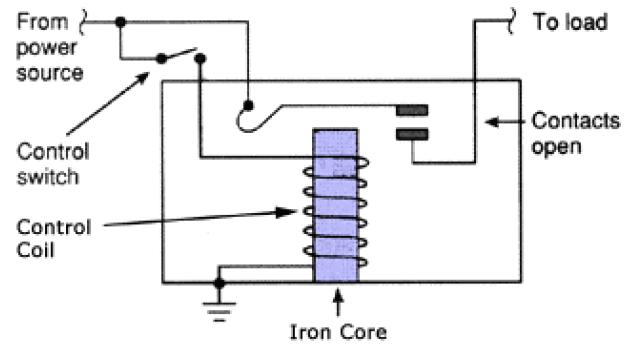
6.3 Relays
A relay is an electromagnetic component that works as a switch. When electricity passes through the coil, it acts like a magent. The coil attracts a moveable metal contact towards another fixed contact. When yhe electricity shops flowing, the moveable contact goes back to its original position.

miércoles, 19 de abril de 2017

6.ELECTROMAGNETIC MECHANISM

6.1 Electromagnetic Generators

Transform mechanical energy into electricity. There are two types of generators, depending on the type of current that is produce. Direct current called dynamos, and produce alternating current are called alternators.


Dynamos:

Consists of a magnet and rotary coil. the coil is located between the two poles of the magnet.
The ends of the coil have two semi.circular conductor, wich form communator.

Alternators:

Is almost identical to a dynamo, exept for the commutator, which consists of two metallic rings connected to carbon brushes. Produce alternating current.

5.1 EFFECTS OF ELECTRIC CURRENT

5.3 Electromagnetic effects.

The scientis Michael Faraday discouvert the opposite effect. He noticed that electricity could be generated by using a magnet and an electrictical conductor this principle allows us to build dynamos and alternators.
5.4 Sound
we can transform the electric current into suond(bells, buzzers). This is based on the piezoelectric effect.

lunes, 3 de abril de 2017

5.EFFECTS OF ELECTRIC CURRENT

5.1 Heat


The energy that an electric current produces as heat is called the Joule Effect. It is expressed by the following formula:  E= I2 x R v t

5.1 Light


There are various ways that electricity can be used to produce ligth.

Incandescent bulbs: When an electric current passes through the metalic filament of a ligth bulb, it produces ligth.

Fluorescent tubes. Inside fluorescent tubes, there is a metallic, normaly made of tungsten.
There is also an inert gas, such as argon, and a small amount of mercury. When an electric current passes through the filament, electrons are emited into inert gas.
Unfortunated, flourescent tubes contain a numbers of toxic substances, such as phosphor and mercury.

4. TYPES OF CURRENT

4.1 Direct current


Between the terminals of a battery, there is a continous, stable flow of energy. This is called direct current.

4.2 Alternating current


If we measured the voltage of an electrical socket, the results could be represented in a graph like the one below:


The variation of any electrical parameter over a period of time (in this case the electric current) is an electric signal.
The tension or voltage of domestic electricity is an alternating signal because it alternates between positive and negative values. Its waveform is also sinusoidal, with a smooth, regular shape.

4.3 The efficiency of alternating current 

The average power of alternating current is equal to the direct current that is needed to produce the same effect. In the case of an alternating sinusoidal, current, the average power would be as foollows

                                                                       V ef=V max/(Square root) 2

4.4 Transformers

Is a difference between alternating and direct current. Alternating current can be increased or decreased by a transformer.
Transformer consist of two windings made of copper wire. If we apply an .alternating current to one of them, it will produce a certain voltage in the other.